During The 20th Century, The Chemistry Of The Automobile Environment
Throughout The World Has Changed Dramatically. As A Result Of These Changes,
The Corrosivity Of The Automobile Environment Has Increased.
Cars and trucks rust, some faster than others, because they are exposed to the
elements whenever they are on the road, and in most cases also while they are
parked. Much progress has been made in vehicle anti-corrosion treatment in the
last 20 years, but the problem still remains.

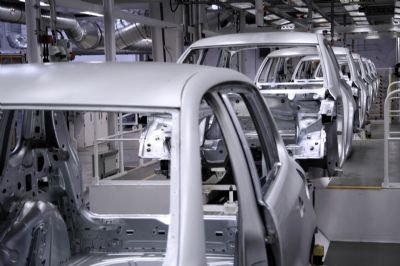
The bodyshell forms the load-bearing structure of almost all private vehicles and
most vans and minibuses. This shell must be light, so that the vehicle can have
good performance and be fuel-efficient. It must be strong to absorb both static
and dynamic forces without deformation. It must provide a large and uncluttered
interior space, to maximise passenger comfort and payload. It must have front and
rear crumple zones, and a strong central section for collision safety.
All of the above, together with economic considerations, dictate that the
bodyshell be made of steel, and have an intricate structure with many inner
structural members.
The short answer: from above, from below and from within.
From above:Vehicles which are normally parked outside may be subject to
continuous exposure to rain and dew, which form a wet surface film, which
eventually erodes the anti-corrosion protection layers. Also, the rain, and
often the dew, work their way past imperfect seals, into inner structures.
Additionally, any chrome body trim forms a parasitic galvanic cell with the
steel body, with the rainwater (plus impurities) acting as an electrolyte. This
causes galvanic corrosion.
From below:Stones impacting the underbody perforate the anti-corrosion
protection layers. Mud, grit, slush and snow (and where used, anti-ice salt) get
sprayed from below into every nook and cranny of the often-complex
under-structure and accumulate there. Accumulated dirt and grit act as a sponge,
keeping the underlying metal surface damp, long after the wet weather has come
to an end – and will eventually clog drainage holes, aggravating the situation.
Even dirt accumulated in dry weather will be transformed into a damp sponge as
soon as the wet weather sets-in.
Particularly critical areas are underbody cross-members and mounting points for
suspension and mechanical components.
From within: Below its outer skin, the bodyshell is an intricate
structure. As mentioned above, water and dirt have many paths into the inner
structure. And, often unseen, the dirt accumulates there over the years, acting
as a sponge whenever it is exposed to humidity. Of course, a humid sponge
sitting on a steel panel will over time attack the protective layers and start
oxidising the steel itself. Condensation also deposits on inner panels, whether
from sudden drops of ambient temperature in humid weather (e.g. at nightfall),
or by the use of air conditioning in the cabin, especially in hot, humid weather
– where the ambient humidity condensates on the cooled steel panels.
Another mechanism by which water gains the inner structures, is where corrosion
has already started under rubber door or window seals. These seals are lifted
from their place by the corroded steel and allow rainwater to go past the seal.
Flooded footwells and soaked baggage compartment carpets are a symptom of this.
In recent years, much progress has been made in corrosion protection
techniques (since approx. the 1990s). Up to the 1980s vehicle bodies were made
from cold-rolled steel, which was then primed and painted. From the 1990s
onwards, steelmakers installed continuous electro and hot-dip galvanizing lines
producing two-sided galvanized steel for car and light van bodies. This resulted
in a significant improvement in corrosion withstand, but still does not
eliminate the problem, as the protective galvanisation is eventually eaten away,
exposing the steel to corrosion. Also, if a vehicle has been in an accident,
unprotected steel will inevitably be exposed, leading to corrosion.
Apart from the bodyshell, suspension components are exposed to mud, grit, slush,
snow (and where used, anti-ice salt) sprayed from the road below.
Exhaust systems corrode because of the water vapour exhausted by the engine in
cold humid weather. If the exhaust system does not reach high temperature during
operation, this water vapour condenses on its inner surfaces, causing corrosion.
As mentioned above, the bodyshell is a vehicle’s main structural element (for
cars, vans and minibuses). As little redundant metal as possible is used in the
quest for a spacious, strong and light structure – numerical design methods
optimise the structure to achieve this goal. So, in the absence of much
redundant metal, any serious corrosion significantly weakens the vehicle
structure, and therefore compromises safety.
According to the NACE publication “Corrosion Costs and Preventive Strategies in
the United States – publication no. FHWA-RD-01-156”, released by the U.S.
Federal Highway Administration (FHWA) in 2002, the direct annual cost of
corrosion for the US motor vehicles sector was estimated to be $23.4 billion, of
which $14.46 billion is attributed to corrosion-related vehicle depreciation,
$6.45 billion to corrosion-related repair and maintenance, and $2.56 billion to
additional manufacturing costs due to corrosion protection operations and
materials.

